

The idea that there are more bacteria in your stomach than cells in your body usually stops people cold when they first hear it. Not even a little. by a considerable amount. There are between 30 and 40 trillion human cells in the human body, but there are about 100 trillion bacterial cells in the intestinal ecosystem alone. It’s not a rounding error. Every living person possesses a different order of magnitude of biological complexity that is doing things that science is just starting to comprehend.
The majority of these organisms have been difficult for microbiologists to study for decades. In this situation, the conventional method—growing bacteria in a dish, observing behavior, and drawing conclusions—fails almost entirely. Strict anaerobes make up the great majority of gut bacteria. When they come into contact with oxygen, they perish.
This means that most of the biologically interesting material is lost as soon as a sample leaves the body and enters the open air. Up to 99 percent of the genetic material in the human gut is thought to have never been successfully cultivated in a laboratory. For years, scientists have referred to it as “microbial dark matter,” and the term is appropriate. It is present. It’s enormous. It was also practically unreadable until recently.
Neither a new growth medium nor a new microscope made a difference. The way researchers tackled the data problem changed. Millions of genetic fragments are produced from a single sample using shotgun metagenomic sequencing, a method that simultaneously extracts and reads all of the raw DNA found in a biological sample.
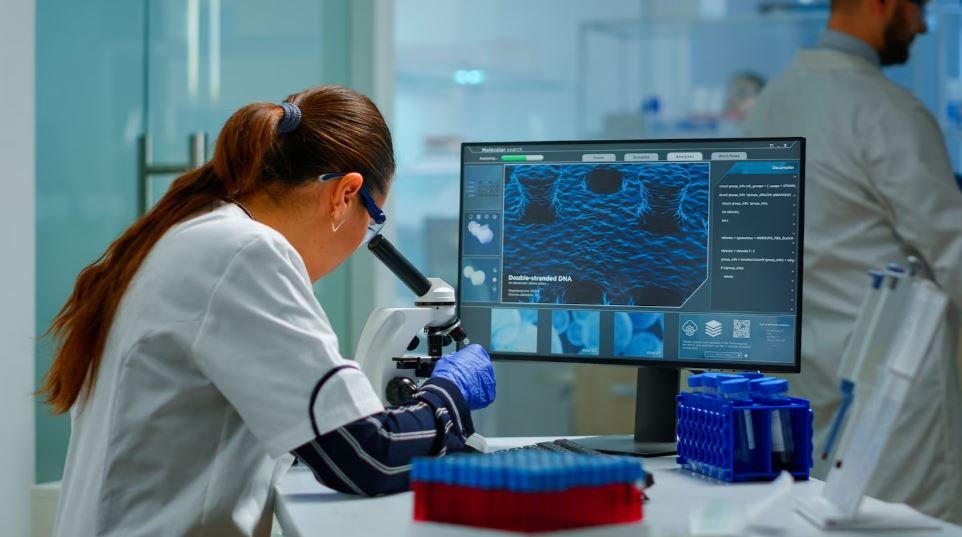
The issue is that these pieces arrive jumbled, resembling a jigsaw puzzle with pieces mixed together from a thousand different boxes. It is not feasible to manually sort them into meaningful genomes. However, AI, especially deep learning frameworks that have been trained to identify patterns in sequence data, can function as an automated puzzle-solver, classifying fragments according to oligonucleotide frequency and sequence similarity to reconstruct entire microbial genomes from what appear to be noise to the human eye.
By approaching genomic structures in the same manner as linguists approach language, Harvard researchers have gone one step further. Based on the same architectural principles as large language models, a genomic language model learns what could be called the grammar of the genome by consuming billions of microbial protein sequences. It determines which genes frequently occur together, which configurations indicate specific functions, and what an unidentified gene is probably doing based only on its location and surrounding context. It’s a truly bizarre concept that appears to be effective.
The question of what a gene does is not entirely resolved by understanding what a gene is. To do that, one must comprehend the protein that the gene codes for, particularly its three-dimensional structure, which dictates how it interacts with other molecules.
This computation has been greatly altered by tools like AlphaFold, which enable researchers to create precise 3D protein models in hours instead of months using unknown gut genetic sequences. New gene families and biological functions that would have taken years to discover through bench work are revealed when those models are compared to current catalogs of known enzymes.
The issue of communication is another. Gut bacteria are not merely silent. They transmit chemical signals, or metabolites, that travel throughout the body and affect immunological response, metabolism, and even mood. The problem is that it’s not always clear how a particular bacterial strain and the metabolite it produces are related. To address this issue, researchers at the University of Tokyo developed a system known as VBayesMM, a Bayesian neural network.
Its handling of uncertainty sets it apart from previous methods; instead of generating confident-sounding correlations that could be statistical noise, VBayesMM flags the reliability of its own predictions, providing researchers with a clearer picture of what is truly a meaningful biological link versus what just so happens to be adjacent in the data. Instead of creating plausible-sounding but meaningless patterns, it consistently found bacterial relationships that matched known biology when tested against datasets from research on obesity, sleep disorders, and cancer.
Where this is going, it’s difficult not to see something subtly important. Microbial shifts, or alterations in organisms like Fusobacterium, that correlate to the early stages of type 2 diabetes or colorectal cancer are already being identified by early diagnostic models, sometimes long before physical symptoms appear. Individual microbiome sequences are being mapped by precision nutrition tools to forecast how a person’s blood sugar may react to particular foods. Clinical application at scale is still genuinely challenging, and the work is still in its early stages. However, the path is sufficiently obvious.
For as long as humans have existed, the gut has stored a vast amount of biological information. Simply put, there were no resources available to read it. Now they are beginning to be.
