
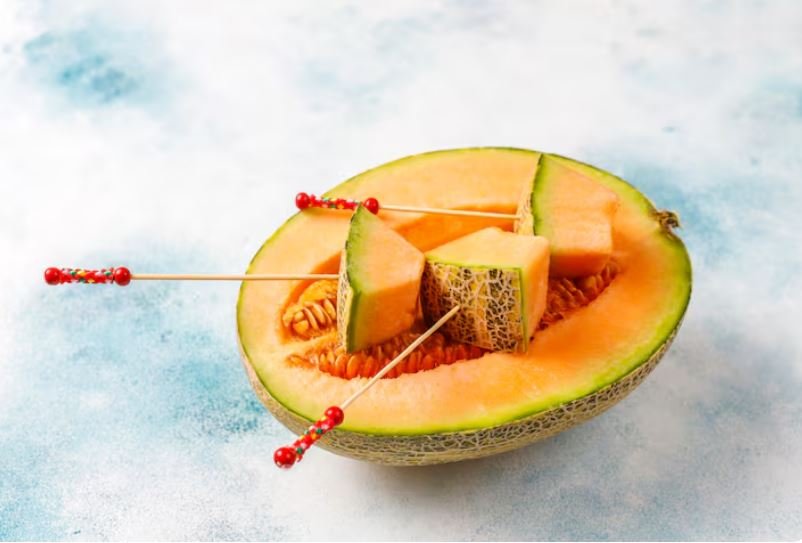
A piece of fruit that appears perfectly healthy and is quietly stored in a refrigerator while harboring a pathogen that has already seriously sickened people all over the nation is unsettling. That’s essentially what happened in the fall of 2023 when, before anyone realized what was going on, Salmonella-contaminated cantaloupes spread through American grocery stores, long-term care facilities, and childcare facilities.
407 individuals from 44 states had contracted the virus by the time the outbreak was deemed to be over in January 2024. Six of them perished. At least 158 people were admitted to hospitals, a figure that is nearly unbelievable when you take into account that the fruit was purchased carelessly.
There was no smoking gun at the beginning of the investigation that solved this crisis. It began with whole genome sequencing, a method that reads a bacterial sample’s entire DNA blueprint and compares it with other isolates from ill patients with remarkable accuracy. It wasn’t a coincidence when health officials observed that Salmonella Sundsvall cases from all over the nation were returning remarkably similar genetic profiles. It was an indication.
The specificity of genome sequencing was what made it so useful in this situation. You can identify the type of Salmonella you have by using conventional laboratory techniques. It is possible to determine whether the bacteria in a patient in Oregon and a patient in Minnesota originated from the same source using whole genome sequencing. They did in this outbreak. Additionally, it was discovered that isolates from sick individuals in the United States were genetically related to cases in Canada. This link turned what may have appeared to be dispersed, unrelated illnesses into a single, cohesive outbreak picture.
Canada had already pointed out something that needed attention. The Canadian Food Inspection Agency discovered Salmonella in samples of “Malichita” brand cantaloupes, which are imported from Mexico and sold through suppliers like Sofia Produce of Nogales, Arizona, and Crown Jewels Produce of Fresno, California. The Public Health Agency of Canada started looking into a cluster of illnesses linked to cantaloupe in early November 2023. The same supply chain was ultimately identified by the FDA’s traceback investigation.
It’s worthwhile to consider the practical implications of that. A cantaloupe that was grown in Mexico, labeled under a brand name, shipped to a distributor in Arizona, then distributed to retailers in 44 states, sliced up in processing facilities, and repackaged as pre-cut fruit sold at stores like Sprouts Farmers Market, Kroger, and Trader Joe’s—somewhere along that chain, Salmonella got in. Because of the size of today’s produce distribution, contamination doesn’t remain local for very long.
The demographic distribution of those who became ill reveals a lot. Those who were infected were 60 years old on average. Almost half were 65 years of age or older. When they fell ill, fifty-two individuals were residing in long-term care facilities. 44 children in daycare facilities were also impacted; 19 of them had been found to have consumed cantaloupe. These are not individuals who are easily immune to Salmonella. A tainted fruit cup is more than just a hassle to them.
At the same time, a different but connected issue was developing on the other side of the Atlantic. The UK Health Security Agency discovered 93 cases of Salmonella Saintpaul, a distinct serovar, that were also connected to cantaloupe consumption between September and November 2023. In Portugal, five more cases emerged. Those under ten made up nearly half of those impacted. In a case-control study, the odds ratio was over fourteen, indicating a strong correlation between cantaloupe consumption and illness. A clearer epidemiological signal would be difficult to come by.
Perhaps more than anything else, the 2023 outbreak demonstrated how reliant on genomic technology modern food safety has become. Cases dispersed over dozens of states might have appeared to be background noise without whole genome sequencing. Investigators could use it to draw a line from a sick child in a Midwest childcare facility to a growing area in Mexico, back through a distribution warehouse, and across a border. At the level of individual nucleotides, the cantaloupe trail—which was invisible to the unaided eye—became readable.
The precise method or location of the contamination’s entry into the supply chain is still unknown. The environmental factors that allowed Salmonella to spread or the growers involved have not been made public by the FDA. It is important to acknowledge that gap in the public record. There has never been better science to identify these outbreaks. It is still unclear if the regulatory framework will catch up to that science and whether growers and distributors will be held equally accountable.
