

When you discover that your most distant ancestors weren’t actually your ancestors as you had thought, you experience a strange kind of vertigo. It was a collision rather than a single thread traveling back in time. a combination. Drifting through the ancient ocean, two completely different kinds of microbial life find each other and, in an unlikely way, become everything.
It’s an odd theory to accept, but it’s currently gaining significant scientific support. According to the theory, about two billion years ago, a member of a group known as Asgard archaea either absorbed or developed a close relationship with a bacterium, giving rise to eukaryotes, the category of complex life that includes every animal, plant, and fungus on Earth, including humans. That bacterium eventually ceased to exist as a distinct organism and evolved into the mitochondria, the energy-producing machinery found in almost all complex cells that are still alive today.
In biology classrooms, archaea have long held an uncomfortable place. They are frequently presented as the peculiar third domain of life—not quite bacteria, not quite what gave rise to us—and then subtly passed by. But over the past few years, that picture has changed significantly.
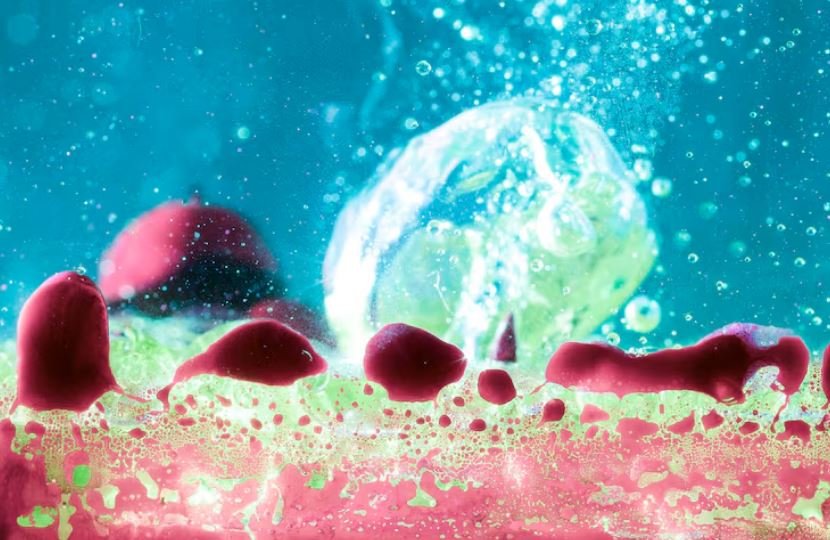
These organisms are far more sophisticated than previously thought, according to research that has been published in journals like Cell and Nature. In particular, Asgard archaea—named rather poetically after Norse mythological realms—contain about 1,300 proteins that were previously believed to be unique to eukaryotes. That is a very impressive figure. It implies that these microbes were, in a significant way, already halfway toward complex life, rather than merely distant cousins.
The merger theory is convincing because it fits the physical record so well. By assembling over 13,000 new microbial genomes—a project involving about 15 terabytes of environmental DNA collected from marine sediments off Uruguay and elsewhere—scientists at the University of Texas nearly doubled the known genomic diversity of Asgard archaea, according to a study published in Nature earlier this year.
The two microbes that were believed to have merged—an archaeon and an alphaproteobacterium—seemed to require incompatible environments, with one requiring oxygen and the other avoiding it, which complicated what had been a difficult puzzle. Certain Asgards, particularly those most closely related to eukaryotes, actually inhabit oxygen-rich coastal waters, according to the new genomes. Suddenly, the long-unsolved contradiction had an explanation.
It’s important to consider the definition of “merging” in this context because the wording may make it seem more organized than it actually was. There was more than one incident that took place on a Tuesday afternoon. It was probably a slow, messy entanglement, with metabolic dependencies accumulating over generations and one organism progressively becoming essential to the other until separation became impossible.
Long before this merger took place, researchers at Monash University have demonstrated that archaea were using hydrogen gas for energy, and it’s possible that the exchange of hydrogen between archaeon and bacteria was what first brought them together. Without fully realizing it, two organisms are helping each other out.
Then there is the question of origins, not of complex life but of life itself. Something even more disturbing is suggested by a different study that was published in Science Advances this past August: bacteria and archaea did not originate from a single free-living ancestor.
Alternatively, they might have developed separately from a common proto-ancestor known as LUCA, or the Last Universal Common Ancestor, which was not fully alive in the modern sense. In order to catalyze the same reactions that enzymes in contemporary cells do, it depended on metals in deep-sea hydrothermal vents. In other words, life might have bootstrapped itself twice, starting from the same circumstances and coming up with two distinct answers to the same issue.
It’s still unclear whether the field will adopt this interpretation, and not all researchers find it compelling. Some scientists contend that rather than emerging independently, bacteria and archaea diverged from LUCA, which was more complex and may have already had primitive cell membranes. These are not minor disputes. They discuss what it means to be “alive” at all.
The pivotal role that archaea play in this narrative does feel more and more established. Organisms that flourish in hot springs, oil reservoirs, and seafloor sediments—places where the majority of life would just vanish—have a lot to say about our origins. That has a subtly arresting quality. It turns out that our closest microbial relatives may be the most extreme survivors on Earth.
